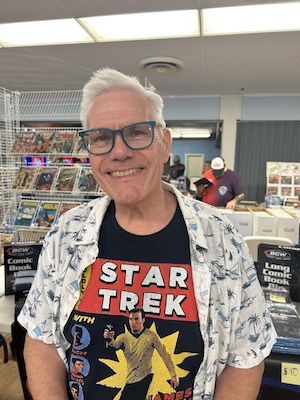
By Dave Smith
Whether you’ve browsed local Midwestern show floors or hunted through longboxes at classic conventions, chances are you’ve bumped into Bruce Reynolds. A fixture of the regional comic community for decades, Bruce’s story isn’t about making a fortune — it’s about a lifelong passion for the medium, the evolution of the fan community, and the simple reality of running out of closet space.
We sat down with Bruce to talk about his early origins, the wild west days of pre-internet comic shows, and three decades behind the dealer table.
Q: How did you first get started in the comic book business, and what inspired you to become a dealer in the first place?
Bruce Reynolds: Selling comics is fun, but I’ve never made a living from it. It really started back in 1976 when we lived in Iowa. My brother Keith sold his collection at a Des Moines Con to help pay for his college, and I tagged along. I was 17 years old, holding a shoebox of comics and 15 Pez dispensers that nobody wanted. I felt like a kid running a lemonade stand.
I dumped all my Hanna-Barbera Gold Key comics — including the first dozen Scooby-Doo issues — for a quarter apiece, and I was just grateful to get anything for them! Keith came home with enough cash to cover half a semester at Iowa State. I came home with a dozen old Marvels, a few Bob Hope books, those Pez dispensers, and a “Howard the Duck for President” pin I bought directly from Steve Gerber. But no cash. I was definitely not a businessman starting out!
Q: How many years have you officially been a comic book vendor now?
Bruce: Officially, 30 years. Our son Alex was born in 1994, and we had completely run out of space at our first home. Rather than just selling overstocks and doubles, I began ripping chunks right out of my personal collection — stuff I’d owned for years as a series completist, but didn’t actually care to revisit. By 1996, I was regularly setting up at shows like Jerry Stephan’s MORE FUN Show at the old Clarion Hotel, which was just recently demolished.
Q: Do you remember the first time you officially attended or set up at the legendary Spector Club comic show? What was that transition like?
Bruce: I first set up at the Kolping House around 1988 or 1990. I’d gone as a spectator for a year or so first, then finally decided to buy a table. I brought along a box of doubles and a few new series I’d read and didn’t really care for, just to see how it went.
Q: What are your strongest memories of those Spector Club shows back at the Kolping House, and how does that era compare to today?
Bruce: It was a BIG hall. Very big. You’d see all kinds of comics from every era imaginable, and the golden rule was to bring all the cash you could scrape together!
There was no internet yet, which meant deals galore and prices were shot straight from the hip. But more than the books, it was about the people. I made so many first-time acquaintances back in those halls who became my best friends. Sadly, many more are gone now — too many. But those Kolping House days were truly special.
Q: What trends do you see shaping the future of comic book collecting and investing?
Bruce: Now it’s like the floor of the NY Stock Exchange. Dealers were once mainly adult fanboys buying & selling for their personal collections. These days most attendees are looking for a deal which they can flip and make money on. Many buyers tell you to your face what price they will pay based on the internet, rather than their own esthetics. That investment strategy didn’t end too well for Beany-Babies, baseball cards, or tulips. We’ll see how Funko-Pops and Comic Books are doing in a few years.
Be sure to stop by Bruce’s tables at the next Spector Club show!


Leave a Reply